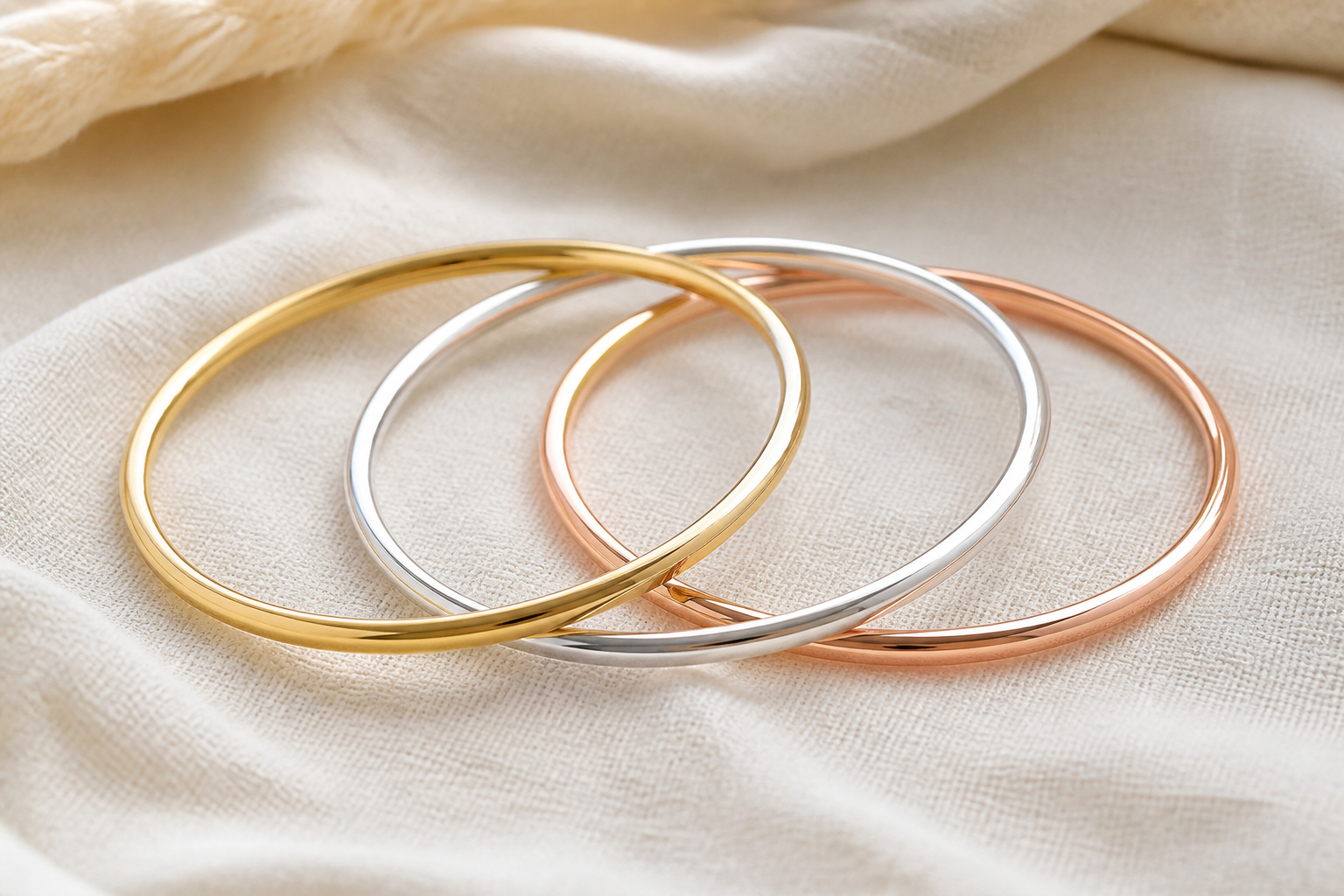
A rigid bangle and a chain bracelet are not two finishes of the same piece. They go on differently, they ask different numbers of the wrap, and they sit differently once the afternoon heat along I-4 has done its work. Families live on the catalog. The tape-and-stack kit is on wrist-measure / stacking.
As an Amazon Associate we earn from qualifying purchases.
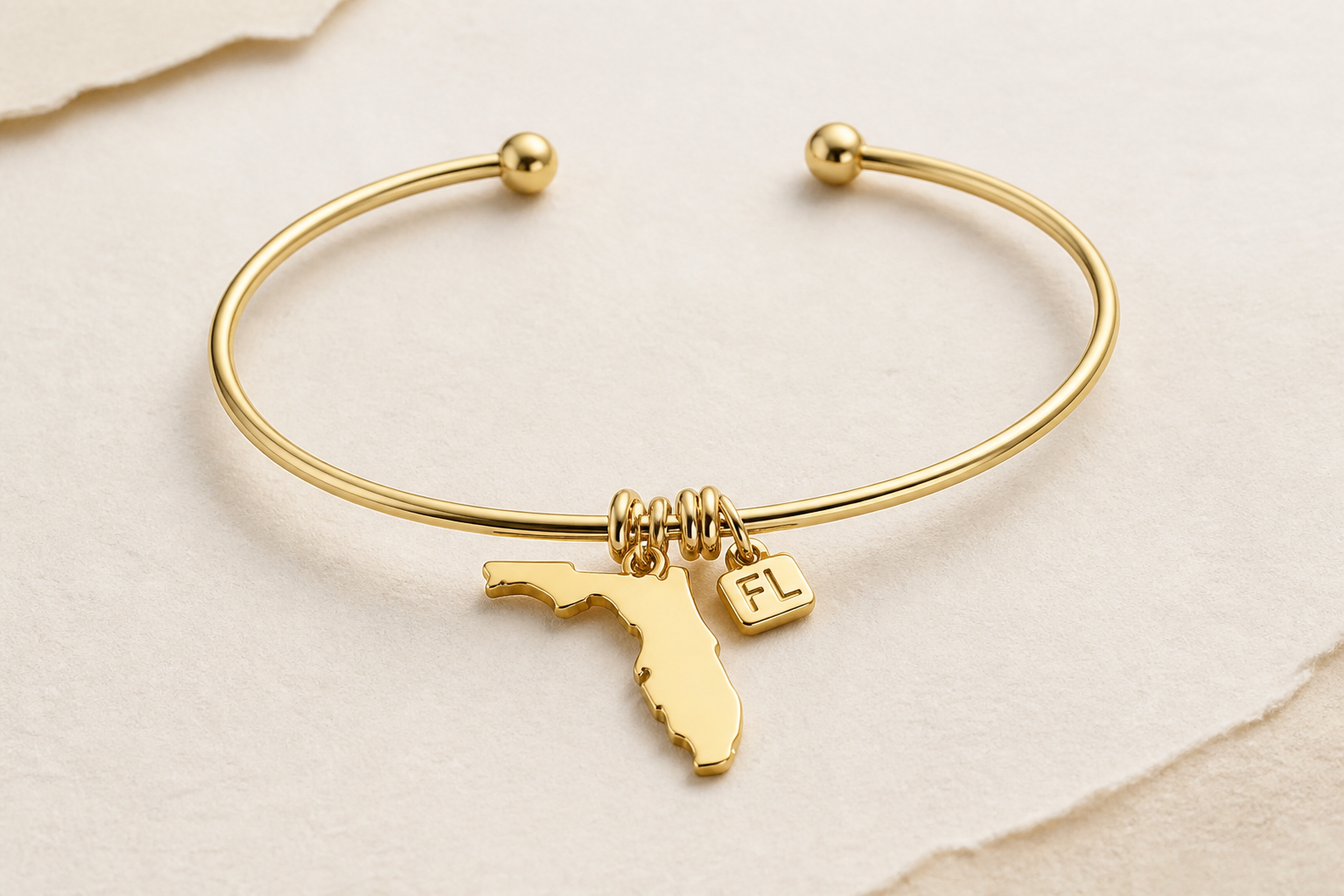
Open cuff. Slides on from the side. A closed rigid bangle must pass the hand.Chain. Opens at the clasp. Never has to pass the knuckles as a closed ring.
How you get it on
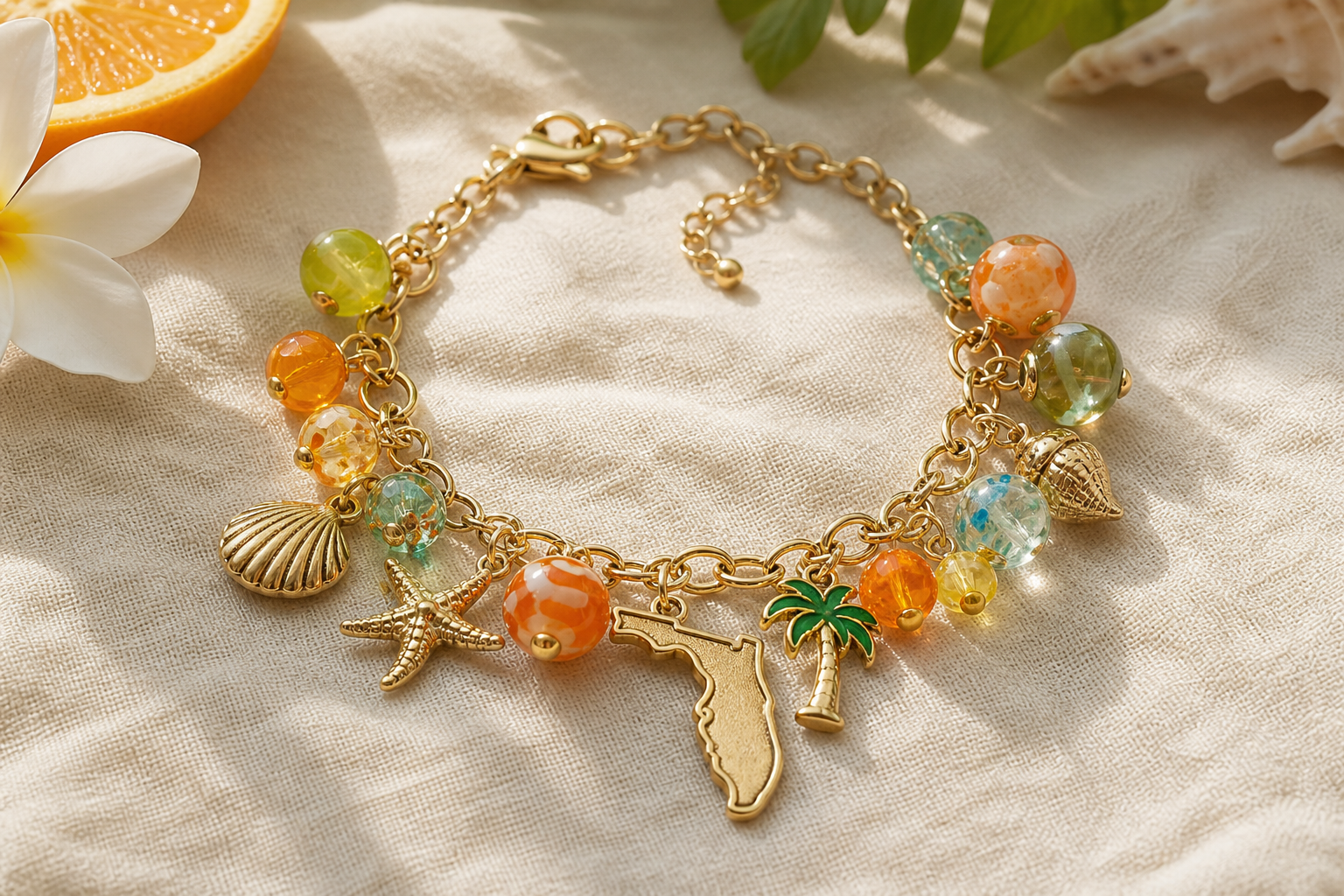
Park-week color on a wrist, not a boutique tray.
A closed, rigid bangle has to pass the hand. You compress the thumb against the palm, angle the piece over the knuckles, and then let it drop to the wrist bone. If it will not clear the knuckles, it will not go on, no matter how well it would sit once it arrived. An open cuff is a different object: it slides on from the side through a gap. A hinged cuff opens like a gate and clicks shut.
A chain bracelet opens at the clasp, or sets at a slider. It never has to pass the knuckles as a closed ring of metal. The hard part is the clasp with sunscreen on the hands, and whether the sitting length still has ease when the wrist has swollen.
The public measure convention
Wrist
Stack
Park week
Beads, color, a cuff that can get wet-adjacent
Hotel dinner
Chain next to a bright band
Gift
Measure first, then pick the loud piece
A common U.S. jewelry-trade convention, published in wholesale size charts such as the Rings & Things bracelet size chart, is to measure wrist circumference with a flexible tape or a strip of paper, then treat a chain or strung bracelet as that wrap plus ease, and a slip-on bangle as inner diameter because it has to pass the hand. The same chart notes that if in doubt you size up, especially when the piece must slide over the hand.
ISO/DIS 25212, Jewellery and precious metals, Bracelet size, Definition, measurement and designation, under ISO/TC 174, is a draft international attempt to define bracelet size, measuring tools, methods, and a mark. It is still in enquiry. It is not a finished retail law.
This company’s measure guide follows the wrap convention: tape or paper, just above the wrist bone, snug not tight, inches or millimeters, then ease, gap, or span by family. Jewelers commonly describe three sits from the same wrap, close, comfort, and loose, and published charts vary on the exact fractions (often about a quarter inch to about an inch of ease on a chain).
Heat
The National Weather Service treats heat index as the temperature the body feels once humidity is counted, and reminds people that published values are for shade. Summer along I-4 is not shade all day. Wrists swell. A clasp that closed at a hotel breakfast can feel mean at three o’clock on International Drive.
Stacking
Jewelers Mutual, in a public stacking note, recommends mixing a stable piece (a cuff, a watch) between looser lines so chains do not tangle, and leaving space so metal does not grind. A rigid bangle is a stable line. A chain is a moving one. Leave a little skin. Do not press a chain under a heavy bangle.
Which number to send
Chain. The wrap, plus how you want it to sit (close, comfort, loose), plus whether it will sit next to a bangle, a cuff, or a watch.
Open cuff. The wrap, and if you already wear one, its inside length and its gap.
Hinged cuff. The wrap, and the join if you care (box catch, hidden clasp, “it opens like a gate and clicks”).
Closed rigid bangle. The wrap is not enough. You also need the hand, the line over the knuckles with the thumb tucked, because that is the hole the bangle has to pass. If you only send the wrist wrap, the bangle may sit and still refuse to go on.
Searches
As an Amazon Associate we earn from qualifying purchases.
Mark a family on the catalog. Paste the wrap. use Contact.
We use cookies to analyze how the site is used and, where this site shows ads, to show advertisements. Essential cookies are always on. You can accept or decline optional cookies.